Hypothesis App by Constructor Tech · Private Beta

See Across a Field From a Single Question


Made by Researchers for Researchers


Ask a research question and it returns the relevant papers, lays out the methods, claims, and contradictions across them, and helps you turn a direction into a testable, evidence-grounded hypothesis.
What It Does

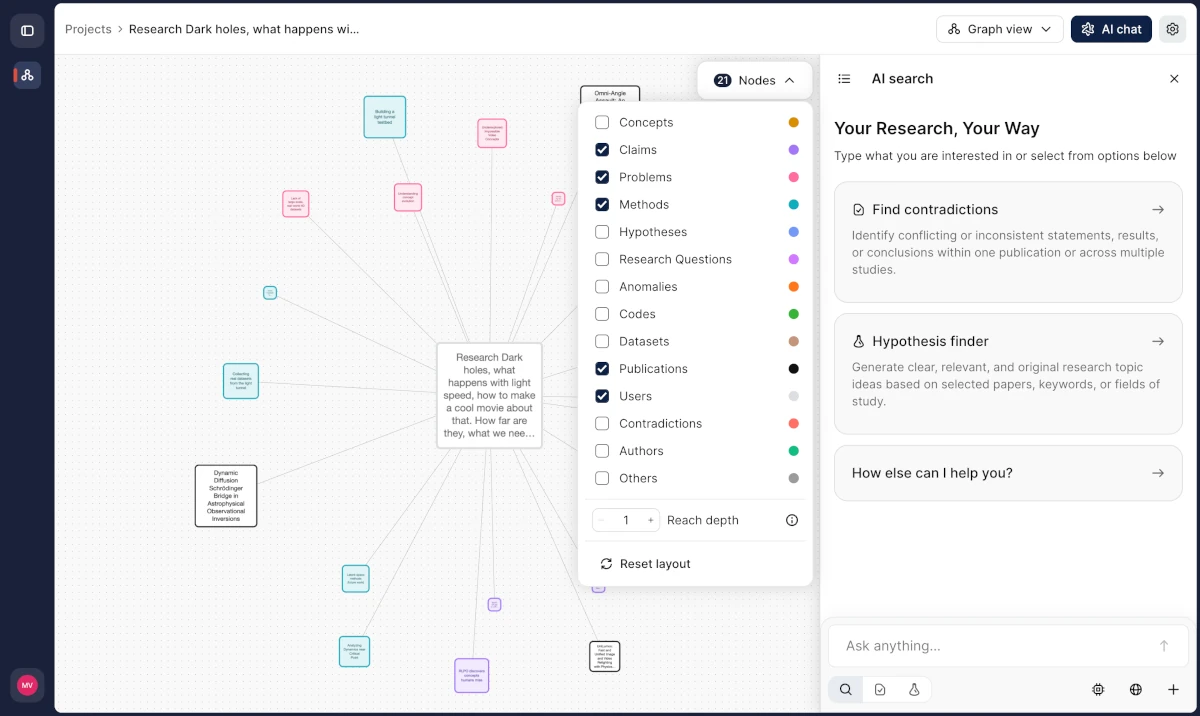
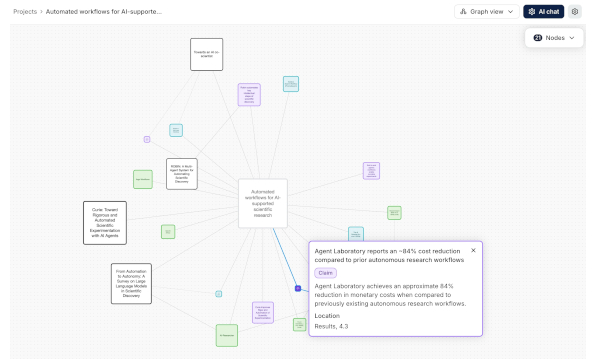
A Research Tool That Maps the Scientific Literature Into Its Methods, Claims, and Concepts

  • Bring your own papers

    Upload your own papers and materials. Your collection is indexed into the same graph, so connections surface across your own library — and it stays yours.
     

  • Fill knowledge gaps with new hypotheses

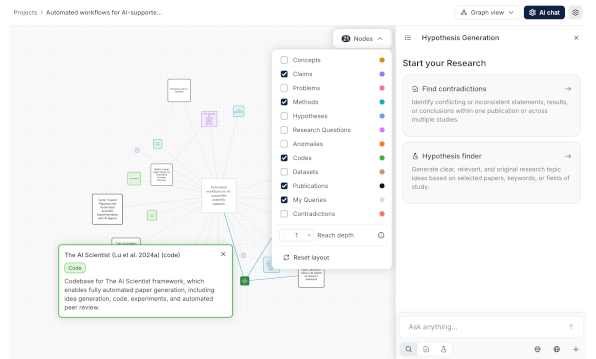
    See the white spaces in a field — open questions, thin evidence, and unresolved disagreements — and fill them with new hypotheses, grounded in and consistent with prior research.

hypothesis-research-screenshot
  • Validate your ideas — get a plan

    Pressure-test a hypothesis and get a concrete validation plan — datasets, baselines, and metrics — each step traceable to the papers it came from.
     

  • Save, export, and reuse artifacts

    Save hypotheses, gaps, and your own notes as artifacts — each one traceable to its source papers. Export them, reuse them across projects, and share by adding collaborators.
     

  • Use it from your own agent — over MCP

    Hypothesis runs an MCP server, so your collections are searchable from MCP-compatible clients — Claude, Cursor, ChatGPT, or custom agents. Bring grounded, source-traceable literature search into the tools you already work in.

constructor hypothesis-small-graph-with-tip

Who It's for

Built for Active Researchers

Principal Investigators

See where a field actually stands — which directions are crowded, which are open, and where the evidence disagrees — with the whole literature in view as you set your group's next project.

Postdocs & PhD Students

Get from a vague question to a focused, citable set of directions — and a testable hypothesis — without weeks of manual reading.

Industry R&D Researchers

Stay current with a fast-moving literature and ground new bets in published evidence.

Today vs. With Hypothesis

What General-purpose AI Tools Miss


Your research taskWith today's AI toolsWith Hypothesis
Reading across many papersChat summarizes one paper, or a few, at a timeProblems, methods, results, and concepts from many papers become explorable nodes in a single graph
Finding knowledge gapsAsk for open problems and you get plausible but generic suggestions — not grounded in a specific body of workUnexplored questions and under-connected areas surface across your collection and the literature — the gaps worth a new hypothesis
Trusting the outputSummaries often work from title and abstract; sources are hard to verifyEvery result traces back to the source paper, built on full-text parsing
Forming a hypothesisA plausible paragraph — ungrounded and hard to reproduceTestable claims with datasets, baselines, and metrics — fully traceable to source

How It Works

Four Steps From Collection to Hypothesis and Research Plan

01 — Index

Upload & index your collection


Add your papers and the collection is indexed: each publication is parsed from full text into its methods and claims, then linked semantically to the rest.

02 — Ask

Describe your question


State your research question in plain language — no query syntax, no keyword tuning.

03 — Explore

Navigate the knowledge graph


Move through papers, methods, claims, and contradictions — filter, compare, and drill into any node back to its source.

04 — Build

Generate & validate


Produce grounded hypotheses and a validation plan with datasets, baselines, and metrics — every artifact traceable to the papers it came from.

Your Data, Your IP, Your Terms

Your Data and IP Stay Yours

No Training on Your Data

Your data is used only for your research. It is never used to train any models.

Your Data Stays Yours

Your inputs, papers, and projects remain private — accessible only to you.

You Own Your IP

You keep full ownership of every artifact you generate — hypotheses, validation plans, and collections are yours.

Compliant, Controlled Hosting

Your data is hosted in line with applicable security and data-protection requirements.

What Researchers Say

Trusted by the People Who Do the Work

The most valuable signal in science is a quiet contradiction between two results that are both solid. Hypothesis finds those, attributes them to specific claims and papers, and proposes what could explain both. No hallucination — only evidence with references.


Prof. Dr. Andrey Ustyuzhanin
Constructor University · ML, high-energy physics, AI for materials discovery

As a researcher, you often need to take birds-eye view of a field, rather than focusing on one paper at a time. Hypothesis maps the literature by revealing claims and contradictions, and methods, helping understanding and accelerating work.


Prof. Dr. Ivar Martin
CASE Senior Scientist, University of Chicago · condensed-matter theory

Private Beta — by Invitation

Join the Private Beta


We're opening Hypothesis to a small group of active researchers. At this stage, feedback from researchers shapes the product directly — beta members have a real say in where it goes next.

How access worksJoin private beta → register → start your first exploration.
Who qualifiesActive researchers — PIs, postdocs, PhD students, and industry R&D. Seats are limited.

What Beta Members Get

  • Free for the full beta
  • Unlimited paper uploads
  • MCP server access
     

Seats are limited and reviewed individually.

Frequently Asked Questions

Is it free during the beta?

Yes. Beta access is free for invited researchers.

Can I bring my own papers?

Yes. Upload your own papers and materials and they're indexed into the same graph — so connections surface across your own library. Your collection stays yours.

How is this different from Elicit, Consensus, Scite, or ChatGPT?

Those tools either rank papers by keyword or summarize them one at a time on top of a search index. Hypothesis builds a graph of how papers relate — their problems, methods, claims, and contradictions — and reasons over that structure. It works from full relational context and shows the source behind every conclusion.

Who can join, and how do I get an invite?

Active researchers — PIs, postdocs, PhD students, and industry R&D. Register now, seats are limited.

What happens to my data and the things I generate?

Your data is never used to train our models, stays private to you and your invited collaborators, and is hosted under applicable security and data-protection requirements. You keep full ownership of everything you generate. (See Your data, your IP, your terms.)

Can I use Hypothesis from my own AI tools?

Yes. Hypothesis runs an MCP server (Model Context Protocol), so you can connect it to MCP-compatible clients — Claude, Cursor, ChatGPT, or your own agents — and search your indexed collections from inside the tools you already use. Access is authenticated with a personal API key, and every result still traces back to its source paper.

How do I give feedback or report a problem?

Join our researcher community on Discord — beta feedback shapes the roadmap.

Contact & Community

Join the Researcher Community on Discord


At this stage, feedback from researchers shapes the product directly. If something seems wrong, missing, or useful, we want to hear it — you'll have a direct line to the team building Hypothesis.