"In the programs, the children are making greater progress than I am teaching. That is something I can say with confidence."
Frauke Simanek, class teacher and learning therapist, Grundschule Wesendorf


Grundschule Wesendorf is a primary school in Lower Saxony, Germany, and part of the national Startchancenprogramm, a program that requires participating schools to demonstrate measurable progress in literacy and numeracy across communities with significant socioeconomic challenges.
With chronic teacher shortages and a wide range of learners in every classroom, the school needed a solution that could support every child without adding to an already stretched staff. They introduced Calcularis and Grafari across all year groups. Every class now uses both programs daily, children are progressing ahead of curriculum expectations, and teachers have a clear picture of each student's level.
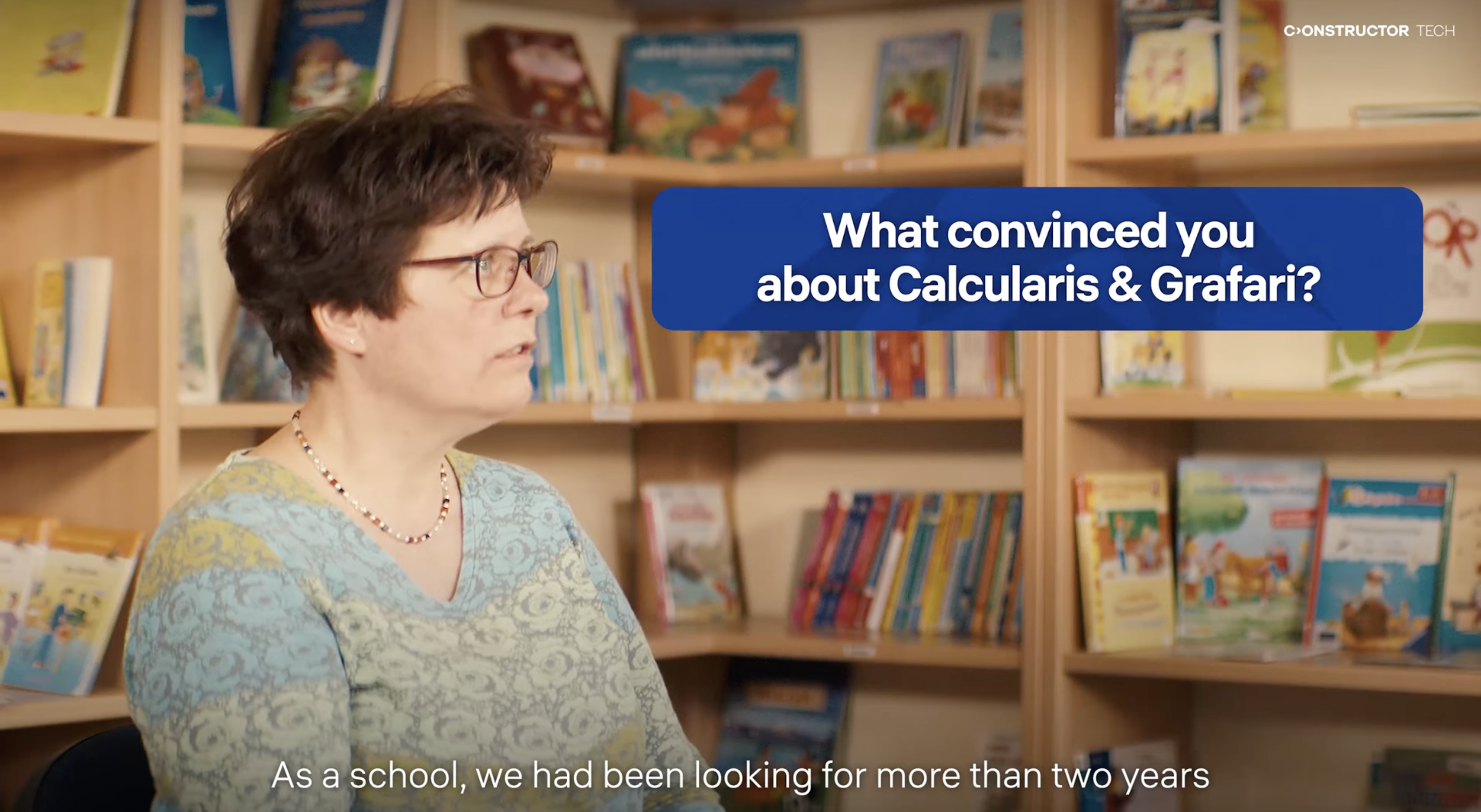
Like many German primary schools, Grundschule Wesendorf had spent over two years searching for a digital tool that could help children build foundational skills in reading, writing, and math without adding to the workload of already stretched teachers.
The school's lead teacher, Frauke Simanek, brought a specific lens to that search. With over 30 years at the school and a qualification in learning therapy for dyslexia and dyscalculia, she was not looking for an app that kept children occupied. She needed something independently evaluated, genuinely adaptive, and stable enough to use in a busy classroom without constant teacher intervention.
Many tools she had tested adapted content only on the surface. None had met the standard she set as a learning therapist.
Simanek first encountered Constructor at a conference run by the Professional Association for Integrative Learning Therapy, where Professor Michael von Aster, the child psychiatrist and University of Potsdam researcher who developed the scientific foundation behind Calcularis, presented his work. Calcularis was developed specifically for children with dyscalculia and later extended to support all learners. Grafari follows the same approach for literacy. Both programs are research-based and independently evaluated, which is what convinced Simanek to bring them to the school's attention.
Close alignment with German curriculum content, so the programs complement regular lessons rather than replacing them
Adaptive learning paths that adjust in real time: children who need more support receive smaller steps, while those who are ready move ahead faster
A child-friendly interface that children navigate independently, with no setup required from the teacher during the session
After an extended trial period, the school brought the decision to a formal staff conference. The outcome was a whole-school commitment. Both Calcularis and Grafari are now used by every teacher in every class, on most school mornings, typically in sessions of 12 to 15 minutes. Parents were also given access to the programs at home, extending structured practice beyond the school day.
Since introducing the programs, Simanek's current Year 1 class has made progress she had not seen before in over 30 years of teaching, in a school that as a Startchancenschule faces some of the most demanding conditions in the system.
By Easter of their first year, more than half of the class had completed all letter sounds and were practicing phonetically accurate writing. This is a milestone that typically falls in Year 2 autumn term. A group of students was already working with addition and subtraction within 100, well ahead of expected curriculum progression.
"In the programs, the children are making greater progress than I am teaching. That is something I can say with confidence."
Frauke Simanek, class teacher and learning therapist, Grundschule Wesendorf
The coach dashboard gave Simanek something she had lacked as a teacher working largely alone across most subjects: a concrete picture of each child's level. The program's assessment consistently matches what she observes in the classroom, closely enough that she now uses it in parent meetings and when reporting progress to authorities under the Startchancenprogramm. Day-to-day operations have also become simpler. When children are absent, parents can be directed straight to Calcularis or Grafari with no materials to prepare. Supply teachers can pick up the tablet trolley and run a purposeful lesson without any briefing from the regular class teacher.
Grundschule Wesendorf is still in the early stages of its Startchancenprogramm cycle and formal outcome measurements are pending. The classroom evidence is already building, and Simanek plans to continue using both programs as the school works toward the measurable improvements the program requires.
Calcularis and Grafari adapt to each child's level, complement your existing curriculum, and give teachers a clear picture of how every student is progressing.